Touring exhibition OVERcoming DICTatorships (CULTURE 2000), organized by the Chair in European Studies of Dresden Technical University (lead partner) in collaboration with the University of Ústi nad Labem, Andrzej Frycz Modrzewski Krakow University College, Open Society Archives Budapest, Institute for the Investigation of Communist Crimes in Romania in Bucharest, University of Trento, University of Birmingham.
Next station: Gallery U Frycza at the Andrzej Frycz Modrzewski Krakow
University College. Opening: 24 November 2008, 12:00.
How do artists who experienced the challenging changes relate to the year 1989 and the then forced or enabled ideological migration caused by collective political-economic upheavals? How do they respond visually to their own specific ‘locations’? During the conference “Roles of the visual in overcoming dictatorships” (CRN fund of the University of Birmingham) and the celebratory opening of the exhibition these questions were examined at the Barber Institute of
Fine Arts at the University of Birmingham on 8-9 October 2008.
The full report which documents the conference and opening speeches of Rt. Hon. Neil Kinnock (London), project leader Prof. Dr. Dr. Gerhard Besier (Dresden) and exhibition convener Dr. Dr. Jutta Vinzent (Birmingham) is now available on
http://lehrstuhl-europastudien.eu/eu/b06_2-2.pdf.
See
http://overcomings.blogspot.com for the video documentation of the project and selected interviews. Featured artist in November 2008: Harald Hauswald (Berlin).
The exhibition was preceded by a Round-Table discussion at the renowned Birmingham Ikon Gallery on 8 November. Chaired by curator Nigel Prince project artists Harald Hauswald (Berlin), Vlad Nancă (Bucharest), Sándor Pinczehelyi (Pécs) and Silvestro Lodi (Venice) presented their personal reflections on the topic to Ikon’s lively audience. Nancă started with putting his two contributions to the exhibition – the installations “I do not know what union I belong to anymore” (2003) and “Ideal” (2007) – into context. His attention is taken by state symbols and how they relate to mentalities and the political practice of a given political
entity. While his sardonic swapping (Erden Kosova) of colours and symbols of the flags of the Soviet Union and the European Union provoked rather harsh moral criticism in the past, he managed to give his recent work combining the flags of communist Hungary, East Germany and Romania a much stronger personal and empathetic note.
“For a few days” in 1989, the artist pointed out, “in each of these countries the national flag was not only without an emblem but with a hole in the middle. To me this is a symbol of pure freedom, something that could only happen in times of such strong spiritual engagement and idealistic vows.” In “Ideal” Nancă put the three flags together in a row in order to construct a spiritual union which encompasses time, history and borders. What combines them is the removal of the symbols used to distinguish, not to unite. The artistic intervention (re-)creates “a spiritual union of genuine revolutionary freedom, where no symbols are spoiling the essence of those days of liberty. It is an Ideal union I wish I could belong to.”
Symbols of political rule also played a pivotal role in Sándor Pinczehelyi’s early 1970s works, in which he had tried to create a genuine Eastern European style. Using hammer and sickle was a means to reveal the isolation from the world and the feeling of a crucifixion, of being forgotten and left behind. The artist wanted to “offload the ideological burden that these objects had collected and then to reinstate them in their fundamental role.” Confronting his former oeuvre throughout the 1990s and 2000s, Pinczehelyi did not simply intend to excavate a past in danger of oblivion but to inter- relate past and present. His works are not only a witness account of
changing structures and values; he touches upon the empty space that is the present. Symbols have not been reinstated; they have lost their meaning. For Pinczehelyi who never saw himself as a “political artist” but touched upon the political that determined his social environment this situation has a far-reaching implication for artistic credibility and responsibility. He aims at “holding up a faithful mirror to the spectator.”
The Brandenburg Gate in Berlin is a magic point in Harald Hauswald’s life and artistic endeavours. The central pair of his photographic contribution is formed by contrasting two snapshots from the early and late 1980s, one depicting the yearning of Easterners craving for
entry to the West, the other the unforeseen day of their admittance in 1989: “People ran out into the world. The earth turned into the globe again.” For Hauswald, who was a great fan of rock music and enriched his photographic skills and archive while exploring Berlin as a telegram messenger, the historical opening of the Brandenburg Gate was an existential experience of freedom. His doings and whereabouts were no longer classified as political and he was finally able to follow his own initiatives. Political topics slowly vanished from his work and his approach to photography changed a lot: “it moved from my mind to my guts.” Where the state as the eternal opponent disappeared, people became visible. Hauswald depicts human
beings as artworks and studies their encounters in public space. Yet his personal appreciation of the transition process reiterates a feeling of emptiness, although in colours different from Nancă’s or Pinczehelyi’s: “What were emotions then are sentiments today.”
Silvestro Lodi, the only Western-born participant at the Round Table, provided the capstone of the East-Western artistic bridge erected during this evening. Fascinated by the procedures, metrics and taxonomies of different professions Lodi dedicates his work to regenerating human actions in the negatives of an ideal-model template. He has been convening them in an encyclopaedic inventory for several years already. Although this practice alone would have
offered intriguing material for discussion, the artist preferred not to present his contribution but his workplace, the city of Venice, to the audience. Following Lodi, who teaches at the Università Ca’ Foscari di Venezia and the Studio Tredici Scuola di Pittura, in Venice there is no hope and no art system at all. Venice is a secluded and touristy “showcase” city devoid of refreshing interfaces with its industrially productive periphery Mestre, which is a
cultural wasteland. Art is neither created nor produced in a process of social exchange any more, but sold on a market. Figuring as market participants and entrepreneurs artists are subject to an economy of rapid interest which defies any standards of intellectual development. “We artists looked at ourselves after years of solipsism. We are now trying to talk to each other, in the hope that the sounds of our voices will reach the ears and brains of our street
companions – critics and art historians.” When Lodi emphatically called for the establishment of new “crossroads” between structures and individuals, he reintroduced a historic concept to our present that in his eyes carries much stronger weight than the memory of all recent dictatorships: “We are in need of a new Renaissance.”

 Franz West - Galerie Gisela Capitain exhibition featuring Tamuna Sirbiladze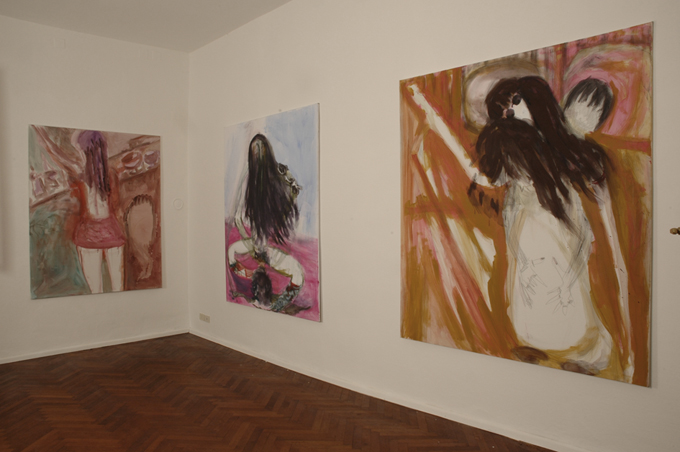


 Posts
Posts


))2/der%20geist%20ist%20ein%20knochen.jpg)